

Game Animals
Non-game Animals
Habitat
Bobwhite Quail
Colinus virginianus
- Popular upland game bird
- Population has declined due to habitat loss
- Habitat loss due to intensive agriculture and industrialization of forestry, introduction of invasive grasses, and loss of native plants
Species Description: Northern Bobwhite Quail
Northern bobwhite quail populations in a given area are determined almost entirely by habitat conditions. The amount, quality and availability of food and nesting areas affect population levels. Bobwhites flock to habitats comprised of native grasses, forbs and shrubs. They are also are found in forest openings, open woods, and along the edges of fields that provide food and adequate cover. Small interconnected farms once provided millions of acres of agricultural fields and pastures for bobwhites.
Bobwhites breed from early May through September. They generally nest in areas with an abundance of native grasses. Nests fall prey to many egg-eating predators as well as forest and farm management activities.
The bobwhites’ population has significantly decreased because habitat loss associated with changes such as industrialization of farming and forestry, loss of native plants, and the introduction of invasive grasses. Their habitats are also lost as grazing practices have changed and more chemicals are used to control weeds.
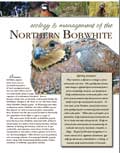
Ecology and Management of the Northern Bobwhite (PDF)
Mississippi State University Extension Service
Northern bobwhite, or bobwhite quail, populations have declined in the southeast over the past several decades. Changes in land use practices have impacted the habitat of the bobwhite, resulting in a population decline. This full-color publication covers the life history and ecology of the northern bobwhite including courtship and nesting, brood rearing, covey structure, and habitat management for bobwhite quail in open lands, forested land, and how to utilize supplemental food plots. This publication also offers some information on the conservation programs for private landowners that can provide financial assistance for habitat management activities, including the Conservation Reserve Program (CRP), Environmental Quality Incentives Program (EQIP), and Conservation Security Program (CSP) of the Natural Resources Conservation Service (NRCS). Readers will find information on population monitoring and harvesting considerations.
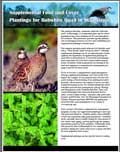
Supplemental Food and Cover Plantings for Bobwhite Quail in Mississippi (PDF)
Mississippi State University Extension Service
A comprehensive management plan for the northern bobwhite, commonly known as the bobwhite quail, is important. If food is limiting the quail population in a location, one component of this plan may be to include supplemental food and cover plantings. These plantings can provide quality, abundant food to quail and may improve cover or nesting habitat as well. The types of plantings that can benefit quail are described in this publication as well as the management techniques for supplemental food and cover plantings and how to manage deer plantings for quail benefit.
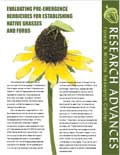
Evaluating Pre-emergence Herbicides for Establishing Native Grasses and Forbs (PDF)
Mississippi State University Forest and Wildlife Research Center
Native warm-season grasses are important habitat for many birds, pollinators, and other wildlife. To increase this habitat, many programs and organizations are promoting planting native warm-season grasses. Failure of these grasses is often due to competition from weeds. This research investigated the use of application rates of pre-emergence herbicide on success of warm-season grasses.
Supplemental Wildlife Food Planting Manual for the Southeast (PDF)
Mississippi State University Extension Service
This guide provides information on food plots and habitat management practices including disking, mowing and prescribed burning. The importance of openings is also discussed. A combination of supplemental forages in food planting is often necessary, as well as testing soil quality, fertilizing and liming. The location, size and shape of food plots as well as how to prepare them and which plants to use is included. An extensive guide on planting materials is given.
Pine Forestland Habitat Management for Wildlife (PDF)
Mississippi State University Forest and Wildlife Research Center
Pine forests can be managed to provide wildlife habitat using a variety of techniques, some of which can improve timber stand quality. Established stands can be managed with thinning, prescribed fire or disking, and even herbicide control of hardwoods which can provide food and cover for quail and grassland species, deer, rabbits, turkey and other wildlife. Regenerating stands can be managed to provide weeds, legumes, and grasses that benefit quail and other early successional wildlife species. Even former agricultural fields can be managed for grassland habitat in conjunction with pine production to include wildlife habitat.
Conservation Reserve Program Mid-Contract Management: Practices for Wildlife Habitat Improvement in Mississippi (PDF)
Mississippi State University and Cooperators
Those enrolled in the Conservation Reserve Program can participate in mid-contract management activities to improve wildlife habitat that are cost-shared. In grasslands, these practices include prescribed fire, light strip-disking, interseeding legumes in introduced grass stands, and herbicidal control of invasive vegetation. In forests, these practices include prescribed fire or light disking, herbicidal control of invasive woody vegetation in pine stands, and herbicidal control of invasive exotic vegetation in pine and hardwood stands. This publication covers management techniques that are cost-shared through CRP in detail.
Grassland Bird Response to Agricultural Field Borders (PDF)
Mississippi State University Forest and Wildlife Research Center
Research performed at Mississippi State University the use of agricultural field border management practices and the impact on grassland bird species. "Within intensive agricultural landscapes, field borders provide important idle herbaceous cover for grassland and early successional birds. Field borders may provide nesting, foraging, roosting, loafing, and escape cover. During winter, field borders may provide important habitat in southern agricultural systems where most short distance migrants overwinter. Field borders provide important habitat for many grassland birds due to their greater abundance of food (weed seeds) and more complex vegetation structure compared to non-bordered field margins.
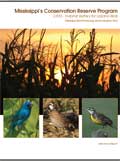
Mississippi's Conservation Reserve Program CP33 (PDF)
Mississippi State University, Natural Resources Conservation Service, Mississippi Department of Wildlife, Fisheries and Parks, USDA Farm Service Agency, Forest and Wildlife Research Center
CP33 field borders or habitat buffers are designed to benefit quail and other grassland bird populations. A research program was initiated in 2006 to study the effects of CP33 native grass habitat buffers on bird populations in Mississippi. The results of this study are presented in this report.
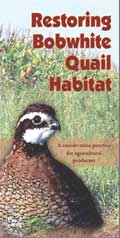
Restoring Bobwhite Quail Habitat (PDF)
MDWFP, MS Fish and Wildlife Foundation, Delta Wildlife Inc., MSU Forest and Wildlife Research Center
This brochure talks about the conservation practice CP33: Habitat buffers for upland birds. Mississippi State University, along with number of cooperators, recently developed a DVD to promote the CP33 practice. The DVD was developed for agricultural producers, and explains both the economics and wildlife benefits of the CP33 practice. Anyone interested in obtaining a copy of the DVD or brochure should contact Wes Burger at Mississippi State University, Department of Wildlife and Fisheries, Mississippi State, MS 39762-9690; email wburger@cfr.msstate.edu. Single copies are free, and larger orders can be purchased for a nominal cost.
Farm-level Habitat Management for Bobwhite Quail and Other Farm Wildlife (PDF)
Mississippi State University Forest and Wildlife Research Center
Practices that agricultural producers can use to increase or improve wildlife habitat on their lands are discussed in this brochure. A brief discussion of managing vegetative buffers, grassland habitat, and woodlands for wildlife habitat is given as well as a mention of the cost-share programs available.
Conservation Buffers: Wildlife Benefits in Southeastern Agricultural Systems (PDF)
Mississippi State University Forest and Wildlife Research Center
Conservation buffers include filter strips, riparian buffers, grass waterways, and field borders. These practices used in conjunction with land management for timber and agriculture can enhance wildlife habitat, provide erosion control, and reduce herbicide runoff. This publication discusses the different types of conservation buffers, the environmental benefits, and the economic benefit to farmers.
Native Warm-Season Grass Restoration in Mississippi (PDF)
Mississippi State University Forest and Wildlife Research Center
This publication defines native warm season grasses, lists examples of the types of warm season grasses and provides labeled drawings of the types. It describes the benefits of restoring native grasses and how to do so. Information is provided on keeping different non-native grass species under control. Information is also given on choosing and planting grass species in a way that restores ecosystems and is advantageous to wildlife or creates livestock forage. Use of periodic disturbances is also covered along with contact information for organizations that assist with management of warm season grasses.
Northern Bobwhite Management on Private Lands - Clay County (PDF)
Mississippi State University Forest and Wildlife Research Center
A working cattle and row crop farm in Clay County is examined for the effects of integrated management on northern bobwhite quail. The specific management practices used and the effects are given.
Northern Bobwhite Management on Private Lands - Coahoma County (PDF)
Mississippi State University Forest and Wildlife Research Center
A large-scale crop farm in Coahoma County is examined for the effects of integrated management on northern bobwhite quail. The specific management practices used and the effects are given.
Northern Bobwhite Management on Private Lands - Panola County (PDF)
Mississippi State University Forest and Wildlife Research Center
A farm in Panola County that produces row crops, forage crops, and forest products is examined for the effects of integrated management on northern bobwhite quail. The specific management practices used and the effects are given.
Light Disking to Enhance Early Successional Wildlife Habitat in Grasslands and Old Fields (PDF)
USDA National Resources Conservation Service
Disking can enhance early successional wildlife habitat which includes annual plants such as the beggar plant, panic grasses, partridge pea and more. Although lasting only one to two growing seasons, these plants produce a large quantity of seeds, which provide food for bobwhite quail and other animal species. This publication provides information on how to disk, when to disk, the recommended intensity of disking, and soil erosion issues.
Conservation Buffers (PDF)
Wildlife Trends, Volume 5, Issue 2
Private landowners can improve wildlife habitat and provide other environmental benefits through practices such as conservation buffers that are easily integrated with production agriculture. Field borders may also benefit the farmer economically by taking low-yielding field margins and enrolling them in cost-share programs. This article discusses the many types of conservation buffers and the benefits that each type can provide. In addition, it provides information on the conservation programs that can provide assistance with the installation of field borders.
Bobwhite Quail in Texas: Habitat Needs and Management Suggestions (PDF)
Texas Parks and Wildlife Department
Basic information to help landowners or sportsmen manage their land for a continuous supply of bobwhite quail.
Bobwhite and Upland Songbird Response to CCRP Practice CP33, Habitat Buffers for Upland Birds (PDF)
Natural Resources Conservation Service
The Continuous Conservation Reserve Program (CCRP) CP33 creates wildlife habitat along field borders of cropland. It was established in 2004. This publication discusses the results from the monitoring program and responses of grassland birds and bobwhite quail to this program.
Partridge pea is an annual plant that is native to Mississippi and attracts birds, butterfly, and rabbits. It is an excellent wildlife plant, especially for bobwhite quail.
The native plants in the sunflower family attract insects, birds, an butterflies. Planting sunflowers can attract these insects and birds to your yard. The flowers are attractive and helpful for pollinators, also producing seeds that birds, including quail, will eat in the winter.